
A likely easing in inflationary pressures in the forthcoming months will reopen the window for the RBI to once again prioritise growth and ease its interest rates.

There is no direct impact of the Russia-Ukraine crisis on India in terms of bilateral trade but a surge in oil prices poses considerable risk to the economy, an analyst report said on Friday. International oil prices which have surged past $100 per barrel "pose risks to external stability and currency movement," a Bank of Baroda Economics Research report said. Russia has launched military operations against Ukraine, stoking fears of significant disruption in the region, including loss of life. The West is ramping up financial sanctions against Russia and support for Ukraine.

Fraud-hit Punjab and Maharashtra Cooperative (PMC) Bank on Tuesday invited expression of interest (EoI) from potential investors for investment or equity participation in the bank for its reconstruction. Subsequent to commencement of the normal day-to-day operations, it will be open for the investors to convert the bank into a small finance bank by making an application to the RBI, the lender said.
The new circular provides for a framework for early recognition, reporting and time-bound resolution of bad loans.
The development comes a day after RCom posted a consolidated loss of Rs 30,142 crore for July-September 2019 due to provisioning for liabilities after the Supreme Court ruling on statutory dues.

At the heart of Friday's case lay an ICICI Bank loan owed by Mallya's Watson and CASL, for which Diageo stepped in as a backstop so that it could be refinanced by Standard Chartered Bank.

With the latest relaxation on withdrawal, more than 84 per cent of the depositors of the bank will be able to withdraw their entire account balance, the RBI said.

'We would advise investors to invest in a disciplined way in equities for the long term.'

The culture of these firms is alien to the Indian financial system. Distressed assets funds are known for their ruthless recovery ethics. Slicing and dicing a company and selling it on a piecemeal basis is their usual practice. This is something Indian banks are finding a little uncomfortable.

While the amount collected is a tad lower than last two years, it may surpass the previous two years' collections by the end of the year.

If raters get away by moving from AAA to D overnight after companies default, as happened with DHFL, YES Bank, RCom, and IL&FS, it shows a complete breakdown in the rating system. It calls for exemplary punishment, not kid glove treatment, says Debashis Basu.

"We humbly request to you to alleviate some of the hardships that we and engineers have been facing, by ensuring that the new Jet management does not further delay our pending salaries dues at the earliest," NAG general secretary Tej Sood said in an e-mail to SBI chairman Rajnish Kumar.

'Rather than cutting and pasting from advanced economies, we should use basic economic principles to think about what is right for India at the stage of development at which we are,' says Chief Economic Advisor Krishnamurthy Subramanian.

Banking shares led the free fall and dragged almost all major European indexes down with them.

Flush with liquidity, banks are eager to lend. And, therein lies the problem, warns Tamal Bandyopadhyay.

'Historically, the lead-up to a general election tends to be excessively volatile and big losses are perfectly possible.'

History would indicate that a recession is not that far off.

If credit card delinquency spells trouble, there may be questions with regard to the much bigger retail sub-categories of car and housing loans, notes T N Ninan.

In the past four months, $7.5 billion has flowed back into domestic stocks, helping the benchmark indices bounce back more than 40 per cent from their 2020 lows.

Jaitley did not say if it will be an outright sale or partial divestment.

'The slide in growth has arisen primarily because we have an NBFC crisis on top of a banking crisis,' points out T T Ram Mohan.

Assume that the rupee will trend lower over the next 10 years as India increases overseas sovereign exposures, and your long-term asset allocation should be geared to deal with this trend, suggests Devangshu Datta

The global economy is projected to expand by 4.2 per cent this year, but rising oil and commodity prices and European debt crisis could hurt the overall recovery, according to Paris-based think-tank OECD.
.jpg)
At the retreat, PSBs had suggested the government cut its stake in these entities to less than 51 per cent over a period of time and empower the boards of individual banks.

The hit to economic activity will be mostly confined to the first quarter. And a third wave, if it materialises, is unlikely to be hugely disruptive for the economy, predicts T T Ram Mohan.
Lack of decisiveness and courage to deal with PSBs may turn out be the biggest impediment to the Modi government's economic initiatives, says Debashis Basu.

'This encourages escapism through the politics and economics of nationalism, made worse by tribalism or nativism, the package accompanied inevitably by the erosion of institutional bulwarks and therefore State capture by powerful businessmen,' notes T N Ninan.

Three stockmarket experts give their best picks for the New Year.
The country's narrowing power deficit and increased coal production may not be indicators of the end of stress in the industry. Amritha Pillay reports.

Billionaire Mukesh Ambani's Reliance Industries Ltd on Friday reported a 12 per cent rise in December quarter net profit on improving oil-to-chemical business, strong continued momentum in retail and steady telecom unit Jio.
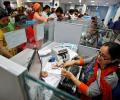
If the earnings in the first quarter of the current financial year are an indication, most banks, particularly those majority-owned by the government, have fared well, reveals Tamal Bandyopadhyay.

Currently, confiscation can be done through multiple laws, but it is a complicated process.

'We try to pick up stocks early and hold onto them for the long term.' 'We are not someone who buys and sells on a daily basis.'

'We are most bullish on all aspects of the financial sector -- private sector banks, even one state-owned bank, insurance, mortgage finance, broking, wealth management, gold finance, etc.'

'People are doing a lot of trading.' 'Short-term euphoria can be seen.' 'Retail participation is best through MFs and PMS.'
The prime minister has promised to fix investment, but world economy is still too weak to fund it.
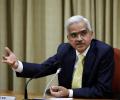
The Reserve Bank of India (RBI) on Friday decided to leave the benchmark interest rate unchanged at 4 per cent but maintained an accommodative stance, implying rate cuts in the future if need arises to support the economy hit by the Covid-19 pandemic.

SC expressed surprise that no steps were taken for recovery.

Investors must, however, be prepared for volatility in ELSS, cautions Sanjay Kumar Singh.
A plunge in fuel demand after the raging pandemic forced people to stay home and stifled the economy dealt a body blow to the firm's traditional cash cow oil refining and petrochemicals, even as consumer-facing businesses, which account for 35 per cent of the oil-to-telecom-to-retail conglomerate's revenues, continued to do well.
